
Features of a Demat Account




- ▶What is Demat Account & What is the Use of it?
- ▶Why do you Need a Demat Account?
- ▶Features Of A Demat Account
- ▶How does Dematerialisation Work?
- ▶Benefits of Opening a Demat Account
- ▶Types of Demat Account
A Demat account's purpose is to ensure the safety of shares, reducing the risk of loss or forgery. To participate in stock market trading, two essential accounts are needed; a Demat account for electronic shareholding and a trading account for swift buy and sell orders. Demat trading was introduced in India in 1996 for NSE transactions. In this article, we will explore the features of Demat account in detail.
What is Demat Account & What is the Use of it?
A Demat account (dematerialised account) was first introduced by NSE in 1996. Shares and securities are held in an electronic format account during online trading. Initially, investors had to manually open their accounts, and it took many days for them to receive authorisation. The process of opening a Demat account online now only takes five minutes.
Why do you Need a Demat Account?
Since investors are allowed to keep securities in both physical and electronic formats, converting physical securities to electronic form is voluntary. However, compared to their dematerialised equivalents, physical certificates are more challenging to manage.
Moreover, it is difficult to buy or sell shares in person. Comparatively, the number of people transacting in dematerialised securities is far higher than the number of agents dealing in physical shares and the number of buyers prepared to purchase physical shares.
- Eliminates loss, damage, forging, and theft of security certificates
- Easy tracking of trading activities
- Allows to add beneficiaries
- Rights issues, split shares, and bonus stocks are automatically credited.
Features Of A Demat Account
Many features of a Demat account can simplify financial transactions:
Easy Share Transfers
Investors can swiftly transfer their holdings when purchasing or selling shares by utilising an electronic Delivery Instruction Slip (e-DIS). On these slips, users may write down all the details required for a transaction to run well.
Demat Accounts Freeze
Demat account holders have the choice to temporarily freeze their accounts if necessary. This option may be useful if one wants to prevent unauthorised debits or credits from being made to a Demat account. Furthermore, there is a dollar limit on the quantity of securities that can be frozen in the account.
Pledging Facility to Get Loan
Several brokers provide loans in exchange for securities that the borrowers have in their Demat accounts. The account holders use their holdings as collateral during loan requests.
SPEED E-Facility
Users can send instruction slips electronically through the National Securities Depository Limited rather than passing them via the DP.
Multiple Accessing Options
Demat accounts are administered electronically. Thus, there are several methods to access them. You may access these accounts using a computer, smartphone, or other smart device that is online.
Corporate Advantages & Initiatives
Any dividends, credits, or interest that companies offer to their investors are immediately eligible for holders of the Demat account. Additionally, information on corporate actions like bonus issuance, right shares, or stock splits is instantly updated on all shareholders' Demat accounts. You can open a Demat account hassle-free, online is a way to invest in the stock market.
The above-stated points are the major features of a Demat account.
How does Dematerialisation Work?
The process of transferring physical share certificates into an electronic format, which is much easier to maintain and available to access from anywhere, is known as dematerialisation. An investor must open a Demat account with a Depository Participant (DP) to trade online. The goal is to make it unnecessary for investors to keep physical share certificates in their possession and to make tracking and monitoring ownership easier.
Demat has sped up the entire procedure and stored security certificates in digital format, helping to simplify the time-consuming share certificate issue process. After your Demat account is activated, you can submit a Dematerialisation Request Form (DRF) along with all of your physical assets to convert paper certificates into digital format. Additionally, don't forget to deface "Surrendered for Dematerialisation" on each physical certificate. When you turn in your share certificates, you will be given an acknowledgement slip.
Benefits of Opening a Demat Account
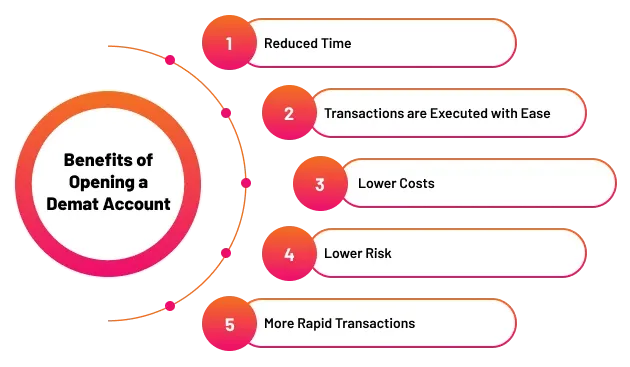
You can explore different benefits that you can get from a Demat account in the below points:
- Customers have been able to cut down the time needed to complete a single transaction because of Demat account. Today, opening a Demat account is required for all new investors in the stock market.
- An investor need not physically visit a business or organisation to buy or sell shares. Instead, a Demat account will enable them to conduct their transactions with a single mouse click. An investor may quickly place an order to buy shares, and the shares will appear in their Demat account within two business days.
- Physical certificates used to come with several extra expenditures, including processing fees, stamp duty, and many other expenses. Due to the removal of Demat accounts, users no longer suffer any additional fees. In the end, this reduces the expense of owning stock in a company.
- There was always a significant danger of loss, theft, forgery, or mutilation while using physical share certificates. However, since the introduction of the Demat account, all of these hazards have been removed from consumers' lives.
- A single transaction in the stock market would need many days to settle before Demat accounts were established.
Types of Demat Account
Three distinct types of Demat accounts are commonly offered by Indian depository participants. Each Demat account has its features.
Common Demat accounts
These accounts are for Indian citizens and are dematerialised. Regular Demat accounts are best for Indian residents who deal in equities trading and investing.
Repatriable Demat Accounts
One of the two types of Demat accounts accessible to NRIs is this one. If you're an NRI, a repatriable account enables you to move money abroad. To repatriate your money, you must link this account with a Non-resident External (NRE) bank account.
Accounts with Non-Repatriable Demat
You can open a non-repatriable Demat account if you're an NRI as well. Transferring money internationally is not possible with this kind of account. It must be connected to an NRO bank account, which stands for Non-resident Ordinary.
- BlinkX launches ItsATraderThing Campaign
- blinkX Introduces 'Options Watchlist' to Empower Traders with Real-Time Insights
- BlinkX Enhances Trading with 24/7 Customer Support Capabilities
- Unlocking Seamless Trading: Introducing “Order Slicing” For The FnO Market
- A Game-Changer for Traders: Introducing Horizontal Watchlists
Features of a Demat Account FAQs
What is a Demat Account in Simple Words?
A Demat account, also known as a “Dematerialized account”, helps users to store their financial securities like bonds and shares in an electronic format.
What is the major benefit of a Demat account?
The main advantage of having a Demat account is that, with the use of online banking, it provides rapid access to all of the investment and statement information.
How much time does it take to transfer shares through the Demat account?
You can easily transfer shares in no time through a Demat account. Therefore, having a Demat account makes the entire process more convenient and faster.
Are there any additional costs associated with a Demat account for users?
Demat account users no longer pay any additional fees because they were eliminated. In the end, this reduces the expense of owning stock in a company.
What fees are associated with the demat account?
Depending on the service provider and the kind of account you select, the fees connected with a Demat account may change.